AB-731: Microsoft Certified AI Transformation Leader, a revision guide
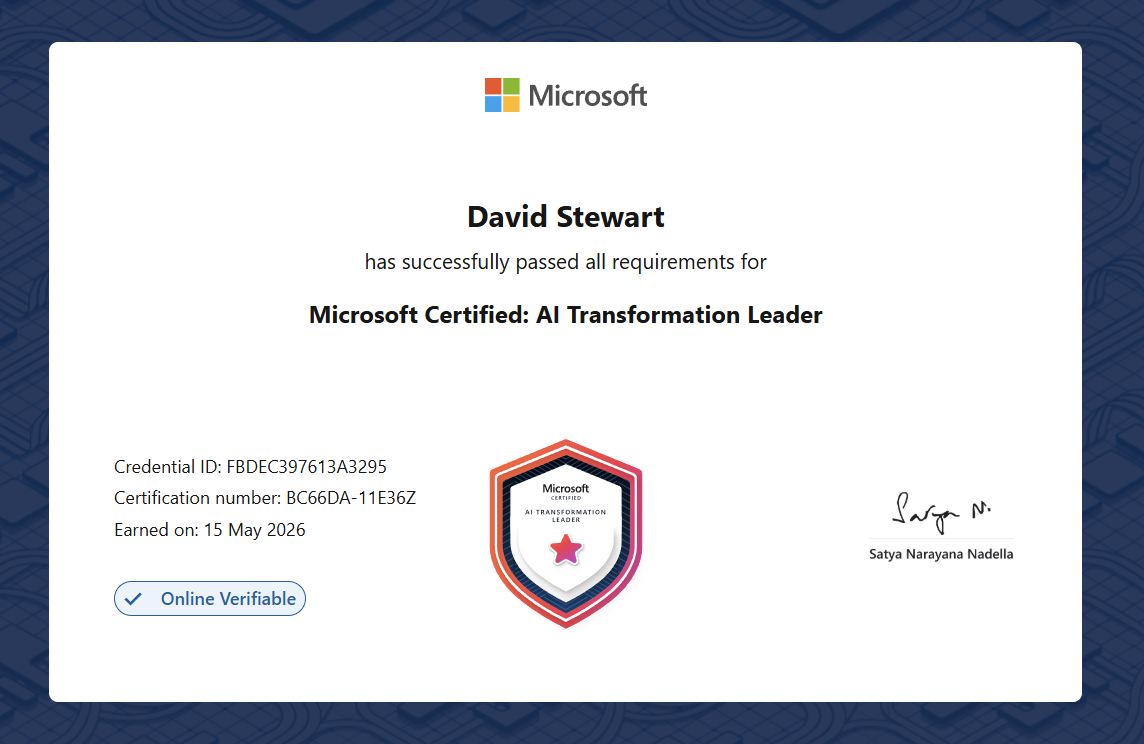
I passed the AB-731 Microsoft Certified AI Transformation Leader exam. These are my revision notes. Three domains with scenario-based questions. Useful whether you are sitting the exam or just want a grounded reference.


Signal Boost: "Open Eye Signal" by Jon Hopkins
Electronic, building, focused. The kind of track that suits the particular mental state of working through something difficult and finding that the pieces are starting to connect. Longer than it feels. Rewards patience.
I passed the AB-731 Microsoft Certified AI Transformation Leader exam with a score of over 900. These are the revision notes I wish had existed when I started preparing. I am sharing them so others can benefit.
The exam covers ground that sits at the centre of most serious AI adoption work right now: how generative AI creates business value, which Microsoft tools do what, and how organisations govern and embed AI responsibly. If you are preparing to sit it, this guide covers the full curriculum with the precision the exam requires.
About the exam
Exam code: AB-731
Title: Microsoft Certified AI Transformation Leader
Format: 40 to 50 questions, 45 minutes
Passing score: 700 out of 1000 (scaled)
Level: No formal prerequisites, no coding required
Who it is for
This exam is designed for business decision makers, including executives, directors, transformation leaders, and senior managers responsible for guiding AI adoption across their organisations. It tests strategic AI fluency, not technical implementation.
The content is an equally valuable starting point for technical roles. Engineers, architects, and product managers who want to understand the business and governance context around the tools they build will find it directly relevant. The exam builds a shared language between business and technical stakeholders. Closing that gap is, in practice, harder than most organisations expect.
What is tested
The exam covers three domains:
| Domain | Weight |
|---|---|
| Domain 1: Business value of generative AI | 35 to 40 percent |
| Domain 2: Microsoft AI apps and services | 35 to 40 percent |
| Domain 3: Implementation and adoption strategy | 20 to 25 percent |
Domains 1 and 2 carry equal weight and together account for the majority of the exam. Domain 3 covers fewer questions but tests nuanced judgement on governance and adoption. It rewards candidates who have thought carefully about how AI change actually lands in organisations.
Most questions are based on scenarios. You are presented with a business situation and asked to identify the right approach, the right tool, or the right principle. The exam tests whether you can reason about real situations, not whether you can recite definitions.
Domain 1: business value of generative AI
What is generative AI and when does it apply?
Most AI systems are built to classify or predict. A fraud detection model identifies anomalies. A demand forecasting model outputs a number. These are discriminative AI systems. They make decisions based on patterns in historical data.
Generative AI does something different. It creates new content by learning statistical patterns from vast training data and producing novel outputs that match those patterns. The exam tests whether you can select the right type of AI for a given business scenario.
| Type | What it does | Typical use cases |
|---|---|---|
| Machine learning | Classifies or predicts from historical labelled data | Churn prediction, fraud detection, demand forecasting |
| Generative AI | Creates new content from prompts | Drafting, summarising, answering questions |
| RAG | Retrieves verified source content at query time, then generates a grounded response | Policy Q&A, internal knowledge bases, compliance queries |
The distinction the exam tests: a customer churn model is machine learning. Writing the personalised retention email to that customer is generative AI. Answering a question about company policy from verified SharePoint documents is RAG.
Pretrained vs fine tuned models
Pretrained models are trained on vast general datasets. They have broad capability but no knowledge of your organisation or domain. Most standard deployments use pretrained models.
Fine tuned models take a pretrained base and continue training on a narrower, domain specific dataset. The model becomes more accurate in that context but requires quality training data, time, and cost.
RAG is not fine tuning. RAG adds verified context at query time without changing the model itself. Updates are immediate. Fine tuning changes model weights permanently and requires retraining to reflect new information.
Exam tip: If a scenario requires current information without retraining, the answer is RAG. Fine tuning is a heavier intervention reserved for cases where domain specific accuracy is essential and quality training data exists.
When outputs go wrong: four distinct problems
This is the section most candidates find difficult, because four different problems can produce outputs that look similar on the surface. Each has a different cause and a different fix.
| Problem | What it looks like | Root cause | Fix |
|---|---|---|---|
| Fabrication | Confident but factually wrong or outdated outputs | Model predicting plausible content, not retrieving verified facts | RAG: connect to verified sources |
| Bias | Systematic difference in outcomes across groups | Training data reflects historical inequities | Address at training data level |
| Reliability | Inconsistent outputs for identical inputs | Model is probabilistic, not deterministic | Prompt engineering, human review |
| Data security | Sensitive data sent to an external provider and potentially retained | No data boundary controls in place | Governance controls, provider policy review |
The distinction the exam will test: outdated product information in a Copilot response is fabrication, not a training data problem. The model is generating plausible content not anchored to verified sources. The solution is RAG, not retraining.
Exam tip: Systematic difference in outcomes across groups = bias from training data. Inconsistent outputs = reliability. Confident but incorrect facts = fabrication. Sensitive data leaving the boundary = security. Each has a different fix.
Prompt engineering
Prompt quality directly determines output quality. The exam treats prompt engineering as a practical business skill. When outputs are poor, the first intervention is almost always improving the prompt, not changing the model.
| Technique | What it does | When to use it |
|---|---|---|
| Zero shot | Ask directly with no examples | Simple, clear tasks |
| Few shot | Provide 2 to 3 examples of desired output before the request | Tone, style, format consistency |
| Chain of thought | Instruct the model to reason step by step | Complex analysis, multi-factor decisions |
| Role prompting | Assign a persona before the task | Shifting depth, vocabulary, or perspective |
Machine learning solution lifecycle
Know this sequence. The exam tests both the order and what goes wrong at each stage.
Define problem → Collect and prepare data → Train model → Evaluate → Deploy → Monitor
Data quality issues in step two produce bias and poor outputs in production. Skipping the monitor stage means performance degradation goes undetected over time.
Cost drivers and ROI
Tokens are the primary cost driver in generative AI. A token is approximately four characters or three quarters of a word. Both prompt inputs and model outputs consume them. High volume use cases with long prompts and detailed responses accumulate cost quickly.
The ROI argument is a volume calculation: time saved per task, multiplied across the number of tasks, compared against licensing and compute cost. Quality matters too. Outputs that require extensive human correction erode ROI on both sides of that equation.
Domain 2: Microsoft AI apps and services
The Copilot licensing landscape
Microsoft has several products with Copilot in the name. The exam tests whether you can select the right one for a given scenario, including whether the requirement justifies the cost.
| Product | What it includes | Cost |
|---|---|---|
| Microsoft Copilot | General web grounded AI chat via browser | Free with Microsoft account |
| Microsoft 365 Copilot Chat | Secure enterprise AI chat, web grounding, Copilot in Outlook | Included with eligible M365 plans |
| Microsoft 365 Copilot | Full app integration across M365, Researcher and Analyst agents, Work IQ | Paid additional licence |
The exam consistently tests cost appropriateness. If the stated need is secure AI chat without app integration, the answer is Copilot Chat, not the full licence. Recommending the full licence when Chat covers the need is a wrong answer.
Copilot in Microsoft 365 apps
The full Copilot licence embeds AI directly into each M365 application. The exam maps specific tasks to specific apps.
| App | What Copilot does there |
|---|---|
| Word | Draft, rewrite, and summarise documents. Apply tone and style changes |
| Excel | Analyse data, generate formulas, identify trends, create charts from natural language |
| PowerPoint | Create presentations from a prompt or Word document. Summarise and redesign decks |
| Outlook | Draft and reply to emails. Summarise long threads. Prepare for meetings |
| Teams | Real time meeting summaries, action items, catch up on missed meetings |
Researcher and Analyst agents
These are specific named agents included with the M365 Copilot licence. The exam tests the distinction between them precisely.
Researcher conducts multistep research across internal work data, including emails, files, and meetings, as well as the web. It produces structured reports with cited sources. Use it when the task is gathering and synthesising information across multiple sources.
Analyst performs advanced data analysis. It works with structured data, including spreadsheets and databases, and produces charts, trend analysis, and written insights. It uses chain of thought reasoning and can run Python code where needed.
Exam tip: Research and synthesis across sources = Researcher. Making sense of data and producing charts = Analyst. The signal words differ. Research, briefing, and drawing from multiple sources point to Researcher. Data, trends, and visualise point to Analyst.
Microsoft Graph and Work IQ
Microsoft Graph is the data layer that connects Copilot to your organisation's content. It provides a single API across all M365 data: emails, calendar, files, chats, and people relationships. Copilot draws on Graph to surface relevant content without being told explicitly what to look for.
Work IQ is built on Graph data. It gives Copilot an implicit understanding of your work context and relationships. It builds over time. A new employee will have less contextually relevant Copilot responses than a colleague who has been at the company for several years. This is not a licence issue. It is a function of accumulated Graph data.
Exam tip: If a question asks how Copilot knows about your recent meetings or relationships without being told, the answer is Microsoft Graph.
Build, extend, or buy
The exam presents a business requirement and tests whether the right approach is to use Copilot as it is, extend it, or build something new.
| Approach | When it applies |
|---|---|
| Buy | Standard M365 Copilot capabilities cover the requirement. Fastest time to value. |
| Extend | Use the M365 Copilot extensibility framework to connect Copilot to internal data or systems. No new agent build required. |
| Build | Use Copilot Studio to build a custom agent for a workflow that Copilot does not cover. |
The exam does not reward building when extending is sufficient. If the scenario describes connecting Copilot to SharePoint or a line of business system, the answer is Extend. If it describes a wholly custom workflow with unique logic, the answer is Build using Copilot Studio.
Microsoft Foundry and Azure AI services
Microsoft Foundry (formerly Azure AI Foundry) is the enterprise platform for selecting, testing, and deploying AI models at scale. It includes built-in security and governance controls and scales on a consumption basis.
The Azure AI services within Foundry each address a specific category of business problem. The exam maps scenarios to services.
| Service | What it does | Signal scenario |
|---|---|---|
| Azure Vision | OCR, document intelligence, image analysis | Scanned forms, handwritten documents, invoice extraction |
| Azure AI Search | Intelligent enterprise search, powers RAG | Internal knowledge base search, document retrieval |
| Azure AI Language | Text analysis, sentiment, classification, summarisation | Support transcript analysis, feedback themes, document classification |
| Azure AI Speech | Speech to text, text to speech, translation | Call transcription, voice interfaces, accessibility |
Exam tip: Scanned documents and images = Azure Vision. Text that already exists and needs to be understood = Azure AI Language. Search and retrieval across content = Azure AI Search. Building, selecting, and deploying models = Microsoft Foundry.
Domain 3: implementation and adoption strategy
Microsoft's eight responsible AI principles
The exam tests all eight principles. A shorter list is a common preparation mistake. Microsoft splits reliability and safety, and privacy and security, into distinct items.
| Principle | What it means in practice |
|---|---|
| Fairness | AI treats all people equitably. No discriminatory outputs based on protected characteristics |
| Reliability | AI performs consistently and as intended across conditions |
| Safety | AI does not cause harm. Safeguards prevent dangerous or unintended outputs |
| Privacy | Personal data is protected and handled in line with privacy obligations |
| Security | AI systems are protected from adversarial attack and unauthorised access |
| Inclusiveness | AI works well for people across different abilities, languages, and backgrounds |
| Transparency | People can understand how AI reaches its conclusions. Decisions are explainable |
| Accountability | Clear human ownership of AI outcomes and system behaviour |
The four most commonly confused in exam scenarios:
| Principle | The signal |
|---|---|
| Reliability | Inconsistent or unpredictable outputs |
| Safety | Outputs that could cause harm |
| Privacy | Personal data rights and consent |
| Security | System attack or unauthorised access |
Exam tip: A tool that sometimes gives wrong answers is a reliability problem. A tool whose wrong answers could cause harm is a safety problem. A question about patient data leaving a system boundary is a privacy question. An adversarial prompt injection attack is a security question.
Governance structures
The exam distinguishes between governance (the oversight structure) and adoption (the enablement mechanism). Both are needed, and the exam treats them as separate concerns.
An AI Council is a body spanning functions, responsible for AI strategy, policy, and risk. It sets the guardrails within which AI is deployed. Membership covers legal, compliance, IT, HR, and business units. It is not an IT committee.
An AI Champions Programme is a network of engaged employees embedded across business units who advocate for adoption, support colleagues, and feed insights back to central teams. Champions are selected for credibility and enthusiasm, not technical skill. They drive adoption through peer influence more effectively than top down mandates.
Usage policies are documented guidelines that define acceptable and unacceptable uses of AI. They make governance operational at the individual user level.
Exam tip: Governance covers oversight, rules, and accountability (AI Council, usage policies). Adoption covers enablement, engagement, and behaviour change (champions, training). The exam treats these as distinct.
Organisational readiness
Before deploying AI, a readiness assessment should cover three dimensions.
Technical readiness covers infrastructure, licences, security configuration, and integration requirements. It is the most visible dimension and rarely the primary barrier to adoption.
Data readiness covers quality, completeness, accessibility, and governance. AI amplifies what is in the data. Poor data quality is the most common cause of poor AI outputs in production.
Cultural readiness covers staff openness to AI, digital literacy, leadership advocacy, and change appetite. It is the least visible dimension until deployment, and the hardest to address quickly once problems surface.
Exam tip: The exam frequently asks which readiness dimension is most likely to be the barrier. Technical issues are visible and fixable. Cultural resistance is invisible until deployment and takes longer to address.
Adoption planning
The exam consistently favours approaches that involve stakeholders early, communicate before deployment, and treat resistance as something to be understood rather than overridden.
Involvement from across the organisation from the outset is the exam's standard answer for stakeholder questions. Options that engage stakeholders late, start with IT only, or rely on mandatory rollout without change management are consistently wrong.
On training, the exam expects a progressive approach. Awareness sessions reach all staff. Capability training is deeper and role specific. Champions receive the most intensive enablement. Sending all employees through the same programme is not the right answer.
Resistance should be diagnosed before it is addressed. Fear of job displacement requires a different response to low digital confidence or scepticism about AI quality. Selecting an intervention without understanding the source is not an answer the exam rewards.
Exam tip: Involve stakeholders early. Communicate before deployment. Train progressively by role. Understand resistance before responding to it. Top down mandates without these steps consistently fail in exam scenarios.
Measuring adoption and business impact
Two categories of metric matter, and the exam distinguishes between them sharply.
Usage metrics, covering active users, frequency, and feature adoption rates, tell you whether the tool is being used. They are available through Copilot usage analytics in the M365 admin centre with a full Copilot licence.
Outcome metrics, covering time saved, error reduction, output volume, and confidence scores, tell you whether the tool is delivering business value. These must be defined before deployment. Without a baseline, there is nothing to measure against.
High usage with no measurable outcome improvement is a metrics gap, not a success story. It almost always means outcome metrics were never defined. The exam will present this scenario and expect you to identify the measurement gap, not blame training or the champions programme.
Exam tip: Usage = adoption is occurring. Outcome = value is being created. High usage with no demonstrable improvement means outcome metrics were not defined before deployment.
Licensing models
The exam matches a licensing model to a scenario. Cost predictability and deployment certainty are the key variables.
| Model | Applies to | When to use it |
|---|---|---|
| Included with M365 | Copilot Chat | Staff need secure AI chat; full app integration not required |
| Monthly subscription | M365 Copilot full licence | Stable deployment, known user count, cost predictability required |
| Pay as you go | Copilot and Azure AI services | Pilots, variable workloads, uncertain demand |
| Prepaid capacity | Azure AI services | High volume, predictable workloads where cost reduction at scale justifies commitment |
Practice questions
These questions reflect the exam's format, based on scenarios. Work through each one before reading the answer.
Domain 1
Q: A financial services firm uses a generative AI tool to draft client communications. Advisors report that the tool occasionally includes product details that are outdated or simply incorrect. What is the most likely cause?
A) The model has been fine tuned on incorrect data
B) The prompts are too short
C) The model is generating plausible sounding content not anchored to verified facts
D) The token limit has been exceeded
Answer: C
This is a fabrication problem, not a training data problem. The scenario does not mention a model adapted on domain specific data. The model is predicting statistically likely outputs. It is not retrieving or verifying facts. The fix is RAG, connecting the model to a verified and current product information source at query time.
Q: A retail company wants to analyse customer purchase history and predict which customers are likely to churn in the next 30 days. Which type of AI solution is most appropriate?
A) Generative AI model
B) Machine learning classification model
C) Retrieval-augmented generation
D) Fine tuned language model
Answer: B
Predicting churn from labelled historical data is a classification problem and the domain of machine learning. Generative AI would be appropriate for the next step: drafting the personalised retention message to send that customer.
Q: An organisation wants to give its generative AI assistant access to internal policy documents so it can answer staff questions accurately. They need a solution that does not require retraining the model. What should they implement?
A) Fine tuning
B) Prompt engineering
C) Retrieval-augmented generation
D) A new pretrained model
Answer: C
RAG retrieves relevant documents from a connected data source at query time and includes them in the prompt context. The model generates a response based on that retrieved content. No retraining is required and updates to the policy documents are reflected immediately.
Domain 2
Q: A senior leader wants to prepare a comprehensive briefing on a competitor's recent market activity. She needs the briefing to draw from recent internal strategy documents, board papers, and current web sources. Which Microsoft 365 Copilot capability should she use?
A) Analyst agent
B) Copilot in Word
C) Researcher agent
D) Copilot in Outlook
Answer: C
Researcher is designed for multistep research that spans internal work data and the web. The scenario has both signals: multiple source types and a synthesis requirement. Analyst is the answer when the task involves structured data analysis, not research and synthesis.
Q: An organisation wants Copilot to answer employee questions about IT support procedures. The procedures are documented in SharePoint and updated weekly. A new custom agent is not required. What is the correct approach?
A) Fine tune a model on the IT documentation
B) Build a custom agent in Copilot Studio
C) Use the Microsoft 365 Copilot extensibility framework to connect Copilot to the SharePoint content
D) Use Azure AI Search as a standalone search tool
Answer: C
The requirement is to connect existing Copilot to existing content. No new agent build is needed. The extensibility framework handles this. Fine tuning is disproportionate and would not reflect weekly updates without retraining. Copilot Studio is for building, not connecting.
Q: A logistics company wants to automate the extraction of data from thousands of paper delivery notes that have been scanned as images. Which Azure AI service is most appropriate?
A) Azure AI Search
B) Azure AI Language
C) Azure Vision in Foundry Tools
D) Microsoft Foundry model catalogue
Answer: C
Scanned documents and image based data extraction require Azure Vision. Azure AI Search retrieves content that already exists in a searchable form. Azure AI Language analyses existing text. Vision is the service that reads and extracts content from images and documents.
Domain 3
Q: A generative AI tool is deployed to assist with performance review write-ups. Analysis of outputs reveals that reviews for employees in certain demographic groups are consistently framed more negatively than others, despite similar performance data. Which responsible AI principle has been violated?
A) Transparency
B) Reliability
C) Accountability
D) Fairness
Answer: D
Systematic negative framing for specific demographic groups is a discriminatory output pattern. The model has replicated or amplified bias present in its training data. Transparency would apply if the decision process were hidden. Accountability would apply if no one owned the outcome. The principle being violated is fairness.
Q: A company has deployed Microsoft 365 Copilot to 500 employees. Six months after rollout, usage data shows 80 percent of licensed users are active weekly. The HR director reports no measurable change in how long core HR processes take. What is the most accurate interpretation?
A) The Copilot licence tier is not sufficient for HR use cases
B) The champions programme has failed to drive meaningful adoption
C) Usage metrics are being tracked but business outcome metrics were not defined, so value cannot be confirmed or denied
D) HR staff need additional training before productivity gains can be measured
Answer: C
Usage at 80 percent is strong adoption. The licence tier and champions programme are not the issue. The problem is that outcome metrics were never defined. Without a baseline and a defined measure of success, it is impossible to confirm or deny whether Copilot is delivering value. This is a measurement gap, not an adoption failure.
Q: An organisation is running a three month pilot of Azure AI services with an unpredictable volume of API calls. Which licensing model is most appropriate?
A) Monthly subscription with a fixed user count
B) Prepaid capacity committed in advance
C) Pay as you go, billed on consumption
D) M365 Copilot Chat, included with existing subscriptions
Answer: C
Unpredictable volume and a short pilot window point to pay as you go. No upfront commitment, billed on what is consumed. Prepaid suits known, stable, high volume demand. Monthly subscription is per user, not consumption based. Copilot Chat is not an Azure AI services licensing model.
A note on content filtering
One area the exam touched on that standard revision materials do not always cover is content filtering.
Content filters are built into Azure AI services and Microsoft Foundry. They evaluate both inputs and outputs against harm categories including hate speech, violence, sexual content, and self-harm. Organisations can configure severity thresholds depending on their use case and risk appetite.
Three specific mechanisms are worth knowing. Input filtering evaluates prompts before they reach the model. Harmful prompts are blocked before a response is generated. Output filtering evaluates model responses before they are returned to the user. Prompt shields specifically protect against prompt injection attacks, where malicious content in user inputs or retrieved documents attempts to hijack the model's behaviour.
Where this sits in the responsible AI framework: content filtering is the operational mechanism that makes the Safety and Security principles enforceable at the system level. It is not a governance policy. It is a technical control that enforces one. That distinction is where the exam focused its questions.
A note on practice tests
Alongside these notes, I found the practice tests on Udemy genuinely useful for honing exam technique and testing recall under time pressure. They complement the conceptual revision well. You can find them here:
AB-731 Practice Tests 2026 AI Transformation Leader on Udemy
What it all comes down to
The exam rewards clear thinking over technical recall. Most questions describe a realistic business situation and test whether you can identify the right tool, the right principle, or the right approach.
The areas where marks are most commonly dropped are the fabrication and bias distinction in Domain 1, the Copilot product taxonomy in Domain 2, and the responsible AI principles in Domain 3. Getting those sharp is where preparation time is best spent.
The content covered in this exam is a solid foundation for anyone involved in AI adoption. The shared language it builds between business and technical stakeholders has practical value well beyond the exam room.